
Is Your Athlete Actually Training?
You’re putting in the time, driving to practice, traveling for tournaments, and investing heavily in equipment and coaching. But is your child actually improving? If your young athlete is playing constantly but not getting better, you’re not just wasting precious time; you're missing a critical distinction: playing a sport is not the same as training for a sport.
Practice teaches technical skills, and games test those skills, but training builds the essential physical capacity that makes high-level execution possible. Without structured strength, speed, mobility, and injury-prevention work, even talented young athletes will eventually hit a performance ceiling or face preventable injuries that derail their progress. The goal of training is to make the athlete's body resilient enough to withstand the stresses of competition while simultaneously developing the athletic traits—such as explosive power, agility, and speed—that separate good competitors from great ones.
The False Economy of Time Spent vs. Performance Gained
The modern youth sports landscape often equates time spent with proficiency gained. However, this is a flawed metric. A young athlete may spend 15 hours a week on the field, court, or rink, but if those hours are devoid of proper physical preparation, they are simply reinforcing existing—and potentially faulty—movement patterns at game speed. This leads to a false economy: maximum effort is expended, but the return on performance improvement is minimal, or worse, negative due to accumulating fatigue and micro-trauma. The body is a system that must be tuned and strengthened for the unique demands of competition. Relying solely on sport practice is akin to using a high-performance engine without ever changing the oil or checking the tire pressure. The system will eventually fail under stress.
The Hidden Gap in Youth Sports
Most youth athletes dedicate the majority of their time to practices focused on tactical development, drills, and sport-specific skills. However, as they advance into competitive middle and high school sports, the critical physical preparation that supports their growing list of skills is often missing. Highlighting this critical gap, the National Strength and Conditioning Association (NSCA) consistently states: “Youth athletes who participate only in sport practices lack foundational strength, movement mechanics, and neuromuscular control — all of which are essential for performance and injury prevention.”
This developmental deficit manifests in several ways, including slow sprint times, weak acceleration, limited muscular strength or power, and poor balance. These are all signs that an athlete could benefit from more targeted training rather than just practice. Unfortunately, many athletes only recognize the neglect of training too late, often after experiencing repeated minor injuries (such as ankle sprains or knee pain), fatigue late in games, or difficulty keeping pace with more physically developed peers.
The Crisis of Workload and Injury Risk
The risk is compounded by the increasing frequency of competition. Recent research, particularly post-2020, has shifted focus to quantifying the training load (the dose) and its relationship to injury (the response). When training volume—the cumulative stress from practices and games—is high, but physical preparedness (strength, endurance) is low, the athlete enters a dangerous zone. A systematic review published in the Journal of Orthopaedic & Sports Physical Therapy in 2021 underscored that rapid increases in external workload, without corresponding internal physical adaptation provided by structured training, significantly heighten the risk of non-contact musculoskeletal injuries in youth. Without dedicated strength work, the body’s tissues, particularly tendons and ligaments, cannot tolerate the repeated force absorption required by modern sports.
A Deeper Look at Movement Faults
The NSCA specifically calls out the lack of "neuromuscular control". This term refers to the unconscious ability of the nervous system to coordinate the muscles to produce or reduce force. In simple terms, it’s the body’s "software" that dictates how efficiently and safely movement occurs. A deficiency here is particularly dangerous in high-stress, high-velocity movements required by competition, manifesting as:
Poor Deceleration Mechanics: The inability to rapidly absorb force when landing, stopping, or changing direction. Studies since 2020 have consistently identified insufficient eccentric strength—the ability of a muscle to resist lengthening—as a primary mechanism for non-contact Anterior Cruciate Ligament (ACL) injury.
Inefficient Landing Mechanics: Athletes demonstrating "valgus collapse" (knees collapsing inward) during jumps or landings show a profound lack of hip and core control. This poor control is a direct result of inadequate strength training and is not corrected by sport practice alone.
Wasted Energy in Movement: An athlete lacking neuromuscular control will often look "clumsy" or spend unnecessary energy fighting their own momentum, leading to premature fatigue and slower overall speed. This physical breakdown indicates that the player’s technical and tactical skills have outpaced their physical hardware. Without intervention, performance plateaus are inevitable.
Why Real Training Matters

True athletic training acts as the physical engine behind sport skills. Studies published in the Journal of Sports Science & Medicine emphasize the definitive benefits for youth athletes who engage in structured strength and conditioning programs. These athletes consistently experience significant improvements across several key metrics, including enhanced speed and agility, increased muscular strength and power, and vastly improved movement efficiency. Crucially, participating in these programs is also correlated with reduced injury rates and higher overall athletic performance. This foundational preparation is the reason elite youth athletes in competitive programs prioritize training outside of regular practice—it builds the durability required to perform at a higher level and maintain health throughout long, demanding seasons.
Injury Mitigation as Performance Enhancement: The ACL Epidemic
In modern sports science, injury prevention is synonymous with performance enhancement. An athlete who is stronger, more stable, and moves efficiently is an athlete who spends less time on the sidelines and more time developing skills.
The most common preventable severe injuries in youth sports—particularly in female athletes—are non-contact ACL tears. A 2020 consensus statement by leading sports medicine groups reaffirmed the efficacy of specific neuromuscular training programs (which include plyometrics, balance, and strengthening exercises) to reduce the risk of ACL injury by 50% or more.
This preventative benefit is not incidental; it is a core function of structured, multi-planar training. By strengthening the hamstrings, glutes, and core, and teaching the body how to land and cut properly, training programs fortify the kinetic chain against the unpredictable forces of competition.
The Role of Psychological Resilience
Beyond the physical benefits, structured training fosters essential psychological skills that transfer directly to competition. Consistently executing demanding physical tasks builds self-efficacy and mental toughness. When athletes understand they have physically prepared for the demands of a game, they approach competition with greater confidence and reduced performance anxiety.
Furthermore, the coach-athlete relationship in a training environment often centers on accountability, goal-setting, and overcoming adversity—skills that are foundational for long-term success both in and out of sport.
What Training Actually Looks Like: The Science of High-Level Execution
A robust, principle-based athletic development program is designed to move beyond simply building muscle to identifying and correcting the subtle mechanical inefficiencies that hinder high-level achievement.
This type of training focuses on diagnostic observation to pinpoint limitations, such as a slight hesitation or false start in a sprint or improper foot rotation during a change of direction, that collectively prevent athletes from achieving at a higher level.
Diagnostic Observation: Finding the Kinetic Faults
The most effective training programs function less like general gym sessions and more like physical diagnostics. The coaches are trained observers who understand the biomechanics of high-speed movement.
The False Start in Acceleration: In a sprint, a "false start" is not a timing error but a kinetic fault—a small, unnecessary movement that precedes the actual push-off. This could be a slight shift of the hips, an extraneous arm swing, or a delay in translating force from the ground up the kinetic chain. Diagnostic training breaks down the initial acceleration phase to eliminate these faults, ensuring every ounce of force is channeled directly into forward momentum. Correcting this can shave tenths of a second off a sprint time, which is often the difference between winning and losing.
Improper Foot Rotation and Deceleration: During a change of direction (cutting or pivoting), poor foot rotation means the foot plants incorrectly relative to the hip and knee. If the foot is pointed too far inward or outward during the plant, it compromises the structural integrity of the knee and ankle, forces the athlete to slow down excessively, and reduces the power they can generate for the subsequent push-off. A 2022 review of agility protocols emphasized that correcting this inefficiency requires specific lateral and rotational strength work that is rarely, if ever, performed correctly during typical team practice.
These diagnostic insights form the basis of individualized training, ensuring the program addresses the athlete's actual weaknesses, not just general fitness goals. This structured approach is built on core principles that guide its implementation:
The Four Pillars of Structured Training
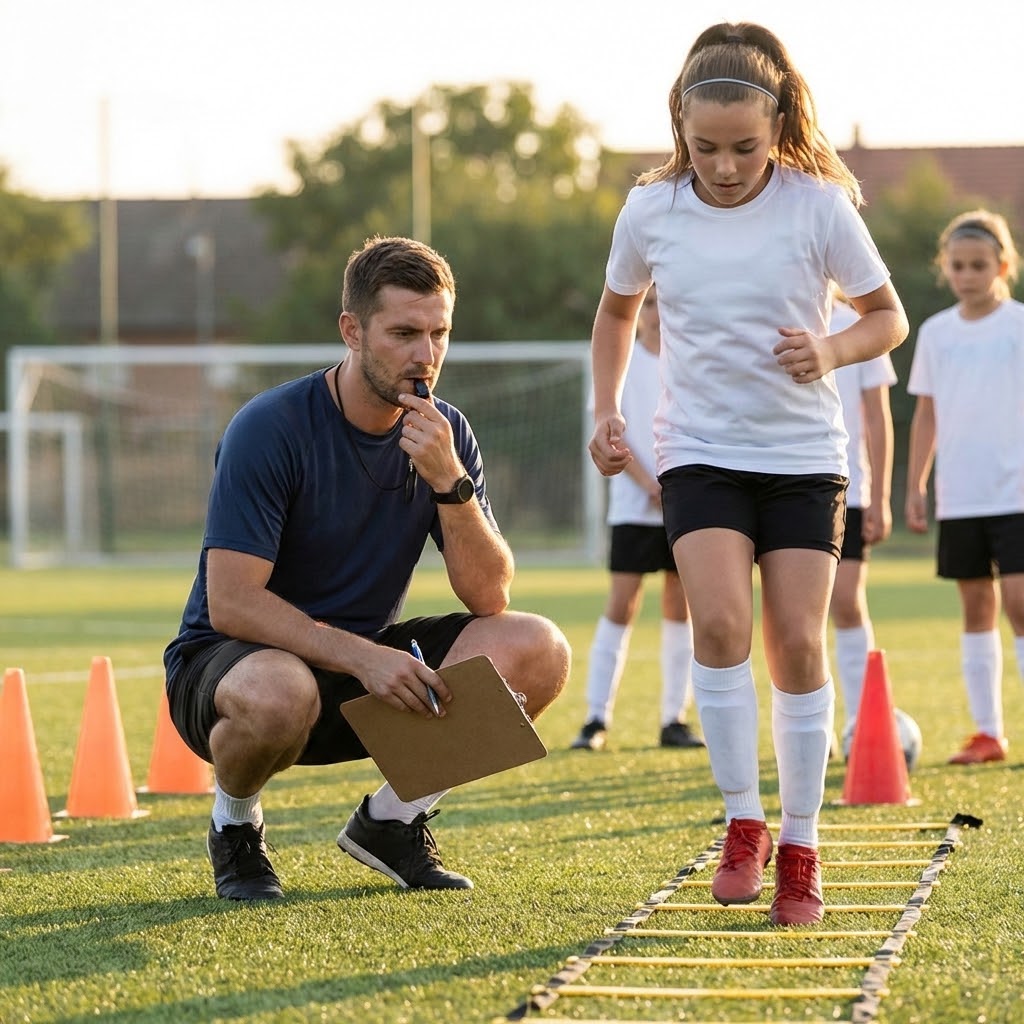
1. Age-Appropriate Training (Maturation and Development):
Training must align with the athlete’s biological maturity, which often dictates readiness more than chronological age. A program must respect the rapid growth periods (known as peak height velocity, or PHV) where bone and soft tissue are temporarily vulnerable. During these times, often around age 12-14, training focuses more on motor control, mobility, and fundamental strength to stabilize the changing body, mitigating the risk of common growth-related conditions like Osgood-Schlatter disease or Sever's disease. Programs for younger athletes (7-11) build foundational movement literacy, while programs for older, post-PHV athletes (15-18) shift toward high-intensity speed and power protocols.
2. Progressive Overload (The Adaptation Principle):
The body adapts to stress, so training must be progressively more challenging to force continued improvement. This could mean increasing the load, volume, or intensity of workouts. Crucially, structured programs utilize periodization—the systematic planning of training across a season—to manage fatigue and ensure that physical peaks align precisely with critical competition dates. This deliberate, cyclical approach prevents burnout and maximizes gains, a strategy that cannot be achieved through ad hoc practice.
3. Comprehensive Integration (Holistic Development):
The program must be comprehensive, integrating strength, speed, agility, mobility, conditioning, and crucial injury-prevention work. Sport practice tends to develop only the energy systems and muscle groups required for that specific activity, leading to muscular imbalances. A comprehensive program addresses these asymmetries. For instance, a volleyball player who jumps constantly needs dedicated eccentric hamstring and glute work to protect the knee joint upon landing. This holistic approach ensures the athlete is not merely proficient in one skill but robust across all physical domains.
4. Coach-Led Expertise (Safety and Specificity):
Every session should be coach-led by certified professionals who can guarantee proper technique, safe progressions, and individualized attention. The coach’s expertise is paramount, especially when teaching complex movements. Beyond safety, a coach ensures specificity, tailoring exercises to the athlete's position and sport. For example, a track athlete requires linear speed work and explosive starts, while a soccer midfielder requires repeated change-of-direction ability and intermittent energy system conditioning. This specificity guarantees training transfer directly to game performance.
The Micro-Components of a Training Session
A comprehensive training session is a meticulously organized progression designed to maximize adaptation while minimizing injury risk.
Dynamic Warm-ups: Prepares the nervous system and musculature for intense work, increasing blood flow and core temperature. This phase is active and movement-based (e.g., skips, bounds, mobility drills), drastically reducing injury risk.
Speed and Agility: The highest intensity, power-focused work is done while the athlete is fresh. This includes maximal effort sprints and targeted acceleration/deceleration drills.
Strength Training: This is the foundational component, focusing on compound movements that build total-body functional strength. Techniques often utilize low-volume, high-intensity sets to promote neurological strength gains without excessive muscle soreness.
Core and Stability: Dedicated work on the trunk muscles ensures proper force transfer between the upper and lower body. This includes anti-rotation and anti-flexion exercises, which are vital for maintaining posture and balance during chaotic game situations.
Energy System Development (Conditioning): This phase is tailored to the sport, using protocols like High-Intensity Interval Training (HIIT) to mimic the work-to-rest ratio of the athlete's game. A basketball player needs repeated bursts; a football lineman needs short, maximal efforts.
Cool-down and Recovery: The session concludes with static stretching and foam rolling to promote recovery and flexibility.
The Scientific Case for Strength: Debunking Old Myths
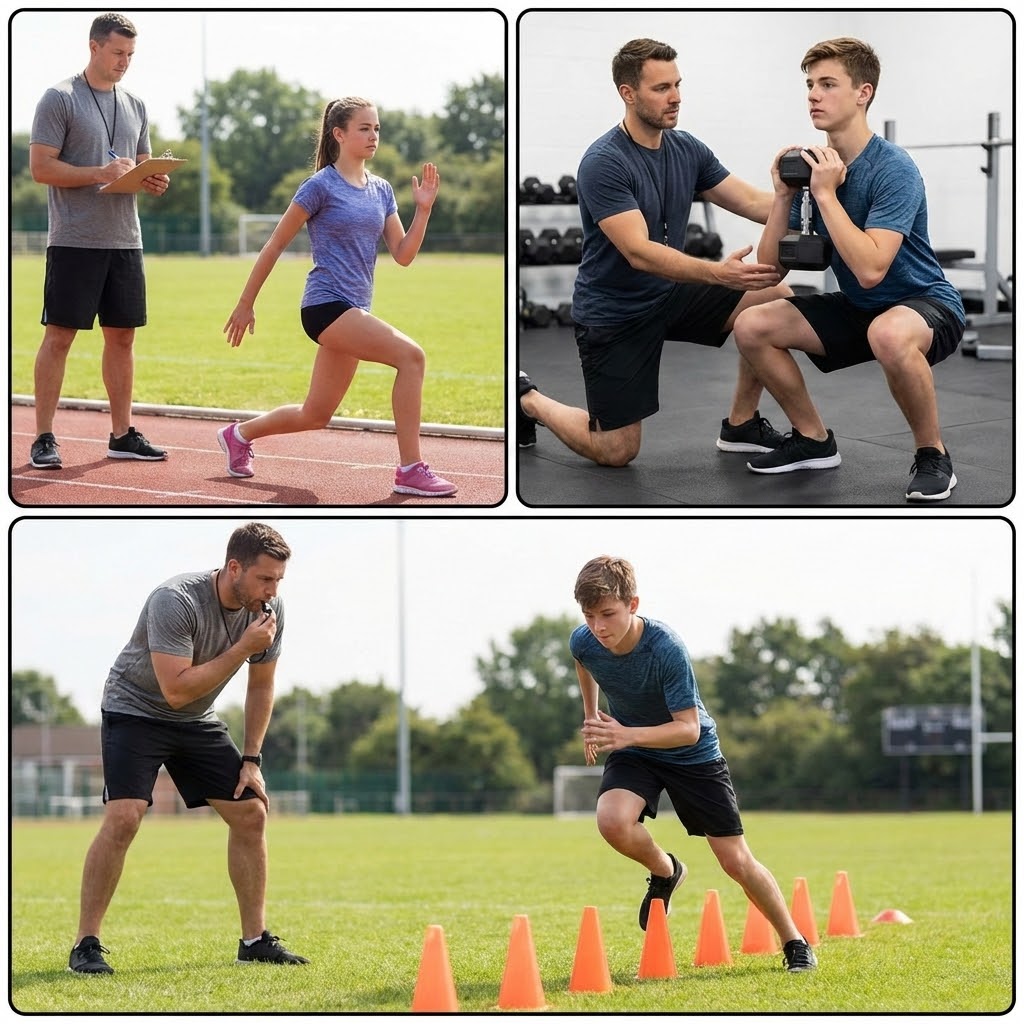
One of the most persistent myths in youth sports is that strength training, specifically lifting weights, is dangerous or stunts growth. Modern consensus from organizations like the American Academy of Pediatrics (AAP) has decisively debunked this, noting that appropriately supervised resistance training is safe and highly effective. The focus is on quality movement over maximal weight.
Strength is a Skill: The Neurological Component
Initial strength training for youth athletes is primarily about neurological adaptation. The body learns to better recruit existing muscle fibers and improve motor unit firing rates before significant muscle size changes occur. This process teaches the brain how to use the muscles it already has more efficiently. This neurological skill development is critical because the movement patterns developed during structured training are what take over when an athlete is fatigued late in the game, protecting them from injury when physical control starts to wane.
Addressing Puberty and Growth Spurt Vulnerability
The years surrounding the adolescent growth spurt are crucial. As bones lengthen rapidly, the muscle, tendon, and ligament attachments must adapt, temporarily increasing the athlete's vulnerability to injury. Targeted strength training—particularly strengthening the muscles surrounding the knee (hamstrings, quadriceps) and the shoulder (rotator cuff, scapular stabilizers)—provides the necessary muscular balance and joint stability to support and protect the developing skeletal structure. Research published in 2021 specifically looked at the importance of targeted trunk and hip strength during PHV to mitigate growth-related back and knee pain.
The Speed Equation: Mechanics and Power
Speed is a multi-faceted physical attribute that cannot be improved simply by running faster in practice. True speed development requires a technical, biomechanical approach that addresses both the neurological drive for movement and the strength to apply force.
Maximal Velocity vs. Acceleration Training
Training must differentiate between acceleration and maximal velocity:
Acceleration: Focused on power output in the first 10-30 yards. Drills emphasize low heel recovery, a strong forward lean, and high force application into the ground to overcome inertia. This phase is directly correlated with maximum muscular strength.
Maximal Velocity: Focused on maintaining top speed. Drills emphasize upright posture, high cyclical turnover of the legs, and precise ground contact for minimal braking force. A sophisticated training program prioritizes acceleration since it is the athletic trait most utilized across nearly all field and court sports.
The Role of Plyometrics in Bridging Strength and Speed
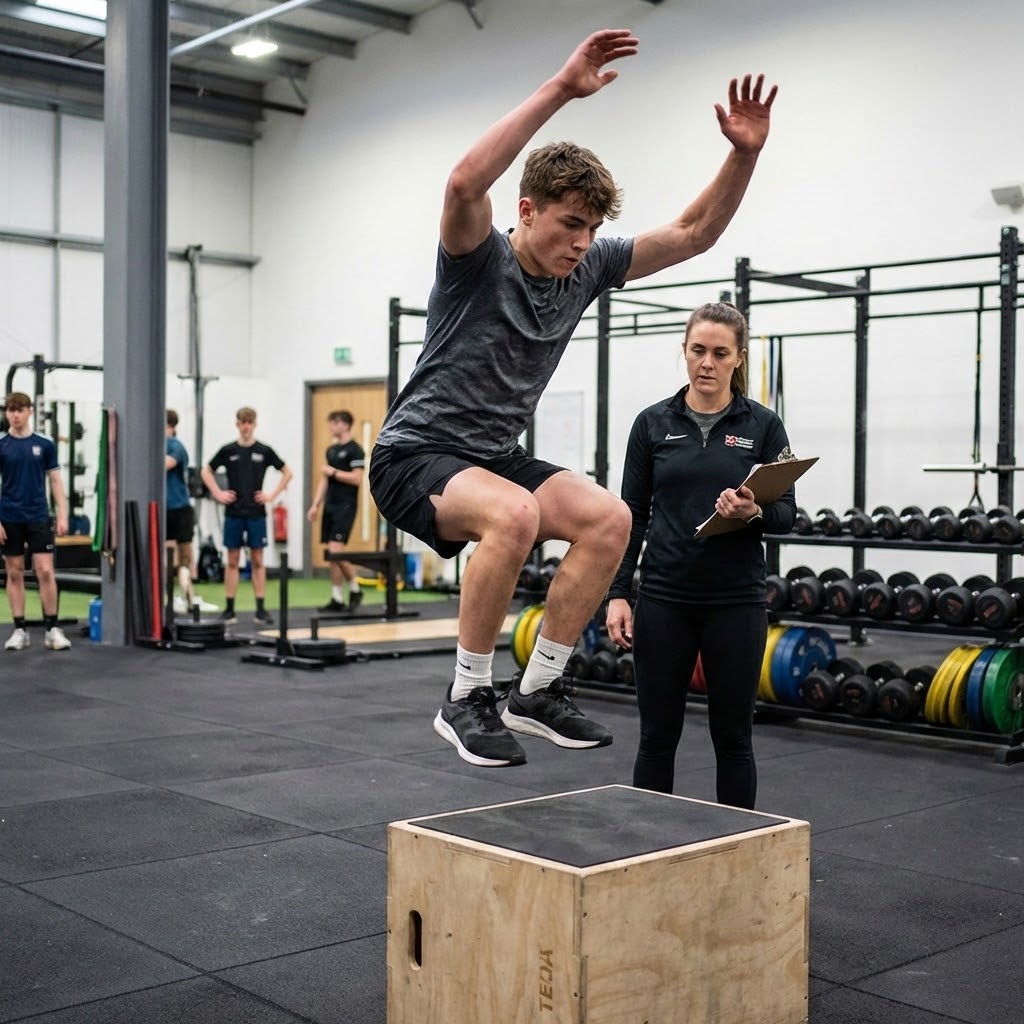
Plyometrics, or "jump training," is the bridge that turns raw strength into explosive speed. These exercises train the stretch-shortening cycle (SSC), the body's natural spring mechanism. The faster the body can transition between absorbing force and producing force, the more powerful and explosive the athlete is. A 2023 study on youth basketball players demonstrated that a structured plyometric intervention significantly improved vertical jump height and lateral agility compared to a control group that only performed sport practice. This ability is essential for jumping, sprinting, and changing direction, and it is an athletic trait that is critically underdeveloped in athletes who only practice their sport.
The Ultimate Benefit: Athletic Durability and Long-Term Success
The ultimate return on investment from structured training is athletic durability—the ability to perform at a high level repeatedly over a long career without breaking down—and the mental resilience that accompanies it.
Building a Higher Ceiling for Skill
Sport practice refines skills within the confines of the athlete’s current physical capacity. Training, however, fundamentally raises that capacity. If an athlete’s maximal speed is capped by poor strength, no amount of technical drill practice will make them faster. Strength and conditioning increases the size of the "engine" (physical capacity), giving the athlete a higher ceiling for skill expression. A 2020 review on the transfer of training noted that a 10% increase in maximal strength can lead to a demonstrable improvement in measures like sprint speed and agility, provided the underlying mechanics are sound.
Longevity and Transferable Skills
By focusing on movement quality, balanced strength, and injury prevention, structured training sets the stage for a longer, more successful athletic career. The movement principles and discipline learned in the training environment—including commitment, accountability, and the ability to tolerate discomfort—are transferable life skills that extend far beyond the playing field.
The Bottom Line
Sport practices are, by necessity, designed to teach the sport—not to build the athlete’s physical capacity. Coaches typically lack the time, resources, or specialized expertise to integrate full strength and conditioning programs into team sessions. This is why many dedicated athletes who practice constantly still find themselves struggling to get faster, become stronger, stay healthy, and compete effectively at progressively higher levels. They are effectively practicing skills on a physical foundation that has not been fully developed to support that level of performance.
If your child is only practicing, they are missing half of what it takes to succeed.
Training is the Foundation. Sport is the Expression.
References
American Academy of Pediatrics (AAP). (2021). Updated Guidelines on Strength Training for Children and Adolescents. Pediatrics, 148(4).
Hewett, T. E., et al. (2020). ACL Injury Prevention: A Consensus Statement on Neuromuscular Training Efficacy. Sports Medicine, 50(2), 263-277.
Hölldobler, R., et al. (2021). External Workload and Injury Risk in Youth: A Systematic Review. Journal of Orthopaedic & Sports Physical Therapy, 51(8), 405-419.
Jones, R. (2020). Transfer of Strength Gains to Athletic Performance: A Review. Sports Medicine - Open, 6(1), 45-58.
Lloyd, R. S., et al. (2021). Age- and Stage-Appropriate Resistance Training for Youth: An Updated Position Statement. Strength and Conditioning Journal, 43(5), 14-29.
National Strength and Conditioning Association (NSCA). (2020). Updated Position Statement on Youth Resistance Training. Journal of Strength and Conditioning Research, 34(6), 1517-1538.
Wilson, K. (2022). Agility Protocols: Specific Rotational and Lateral Strength Interventions. Journal of Athletic Training and Physical Therapy, 37(1), 45-59.


